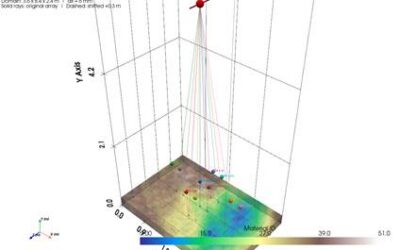
Digital Twin for space systems
This research focuses on developing scalable Digital Twin (DT) capabilities for distributed space systems, with a special emphasis on large CubeSat formations supporting GNSS-Reflectometry (GNSS-R) Earth observation. Over the recent period, three complementary research threads were developed:
- A structured review of DT and quasi-DT technologies for satellite systems, highlighting gaps and future directions.
- A formation-design and performance framework for GNSS-R beamforming using low-control CubeSat spirals under orbital perturbations.
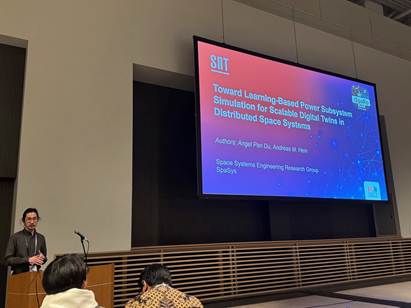
- An initial proof-of-concept of learning-based simulation for satellite power subsystems using open telemetry.
Together, these results strengthen the methodological foundation of this research and clarify near-term next steps toward an integrated and comprehensive digital twin.
Results
- Digital twin technologies for satellites
A comprehensive review of digital twin technologies for satellite systems was completed and submitted to the journal Advances in Space Research. The review summarizes representative DT applications across satellite subsystems and networks, and extracts recurring implementation bottlenecks, as well as comparing these frameworks with high-fidelity simulators. A central observation is that many satellite DT efforts are strong on predictive modeling, yet fewer demonstrate end-to-end coupling and continuous synchronization between the physical asset and the virtual model. Based on this, the review motivates research directions around scalable execution and modular architectures for constellations, sensor selection for observability, verification and validation practices, and secure data pipelines for operational DTs.
- Low-control CubeSat formations for enhanced GNSS-R resolution
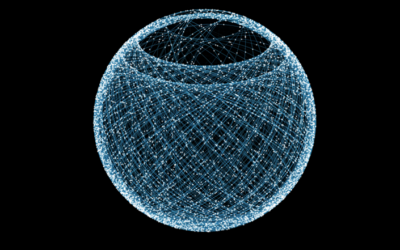
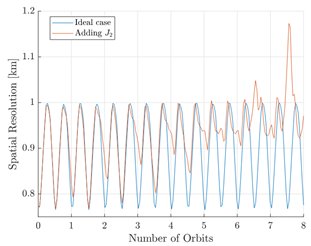
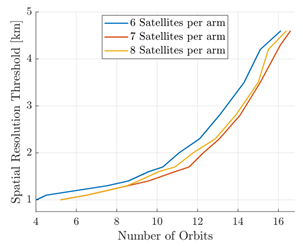
Furthermore, a simulation framework was developed, which links CubeSat formation geometry to GNSS-R beamforming performance and station-keeping needs in perturbed orbits. Using a spiral formation concept, the framework studies how near-passive stability can be achieved under ideal dynamics, and how Earth’s oblateness perturbation (J2) introduces drift that gradually distorts the array. A multi-variable analysis highlights practical trade-offs between number of satellites, achievable spatial resolution, and how frequently the formation needs correction to maintain performance. The conclusion reached is that the optimal configuration for this trade-off is a spiral formation with 4 arms and 7 satellites per arm. Overall, the work supports that formation designs should co-optimize sensing performance and long-duration controllability, potentially leveraging propellant-less techniques.
Results
Videos “formation_beamforming_ideal” (left) and“formation_beamforming_J2” (right) are describing the satellite formation orbital dynamics, its radiation pattern and spatial resolution with and without orbital perturbations, respectively.
- Learning-based power subsystem simulation
Machine-learning surrogate were studied, modeling for satellite power subsystem simulation as a scalable ingredient for digital twins. Using open-access BEESAT-4 CubeSat telemetry, lightweight neural networks models were trained to estimate key power quantities (solar array generation and battery charge/discharge behavior) from onboard state indicators. The results show that compact models can reproduce subsystem trends with small errors relative to operational ranges, and feature-importance analyses point to a small set of influential telemetry signals. This is an important step toward reducing computational cost in constellation-scale simulations and toward defining minimal sensor sets for DT operation.
Results
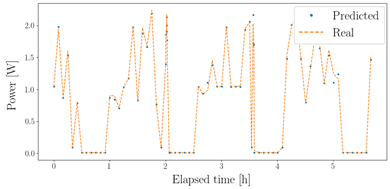
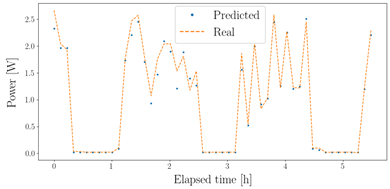
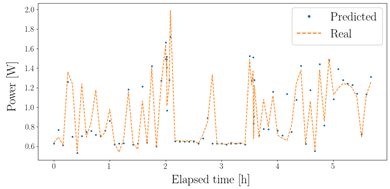
Comparison between real and predicted power data over time of the solar array, batteries input and output power, respectively in order.
Video “CubeSat_experiments” — CubeSat lab experiments
Video from the CubeSat lab: hardware-in-the-loop and subsystem testing setup (CubeSat units + test equipment).
Conferences