GNSS-R experiments
The research centres on advanced GNSS signal processing, with a particular focus on GNSS Reflectometry (GNSS-R). It aims to adapt and optimize GNSS receiver architectures for reflectometry applications while preserving system flexibility. A key aspect is the development of mitigation strategies for non-synchronized or loosely synchronized hardware. The overall objective is to realize robust, scalable, and low-complexity GNSS-R systems that minimize reliance on strict hardware synchronization.
Research Results
The main contribution is a novel GNSS-R altimetric method based entirely on signal modelling, enabling operation with two fully independent, non-synchronized GNSS receivers. GNSS-R leverages signals of opportunity from Global Navigation Satellite Systems and their surface reflections for applications such as altimetry and environmental monitoring. Conventional approaches typically require tight hardware synchronization, increasing system complexity and limiting design flexibility.
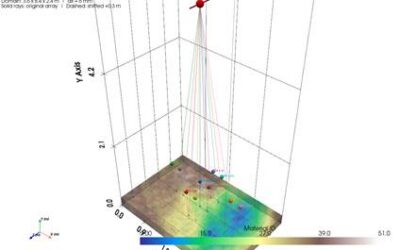
The proposed method removes this requirement through a modelling-driven framework that incorporates the temporal evolution of direct and reflected observables, clock biases, and time offsets within a bistatic geometric formulation. Altitude and synchronization parameters are jointly estimated using a unified least-squares approach, allowing timing inconsistencies to be compensated in post-processing without external references.
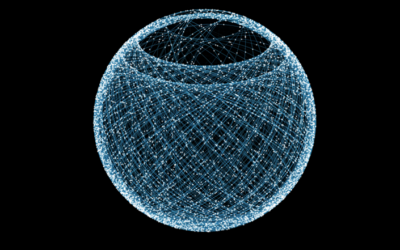
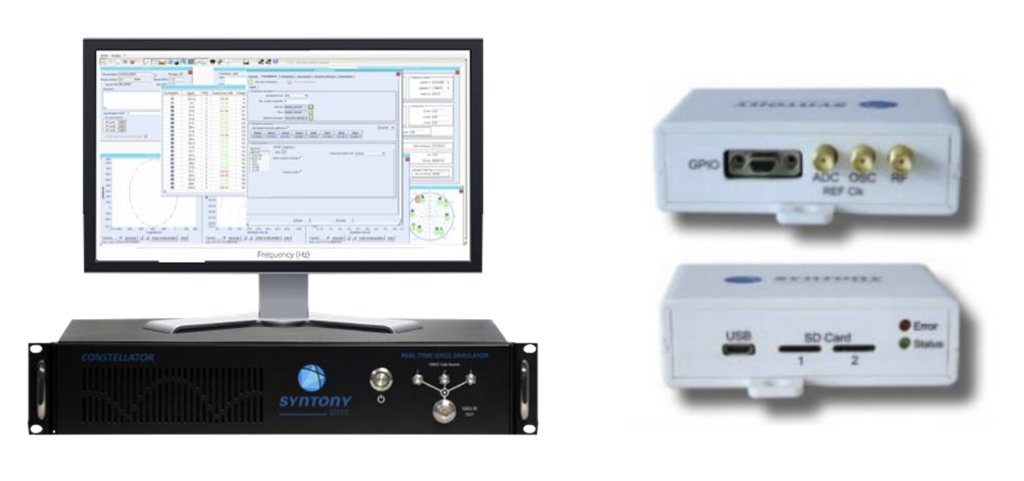
A proof-of-concept campaign based on synthetic data was conducted to validate the methodology. The signal-related data were simulated using Constellator (Fig. 1), an RF signal simulator enabling controlled generation of direct and reflected GNSS signals under a bistatic configuration. The results demonstrate reliable altimetric retrieval using fully independent GNSS receivers, robust joint estimation of altitude and synchronization parameters despite the absence of hardware synchronization, and confirm the soundness of the modelling-driven framework.
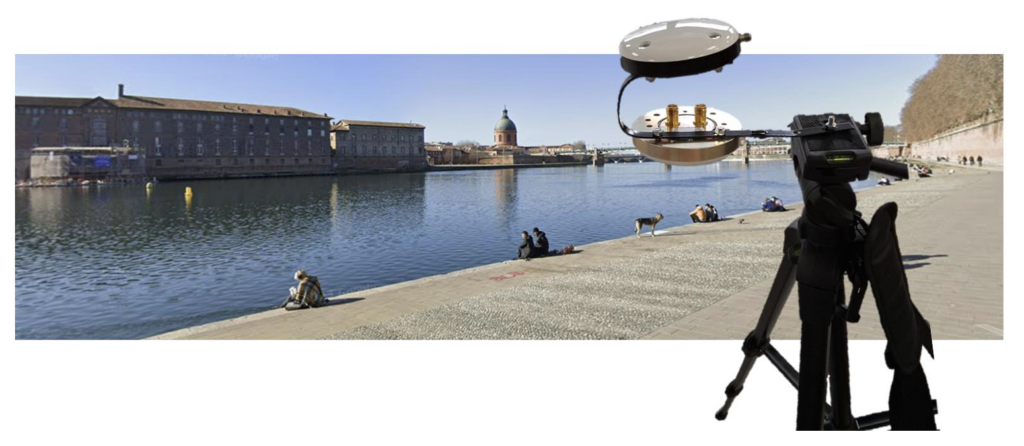
This simulated campaign constitutes the first step toward the overall objective of the activity, i.e. validating the method using real RF data. With the modelling framework established under controlled conditions, the next phase transitions to experimental verification in a sub-optimal, real-life environment. An on-site campaign will therefore be conducted on the Garonne river quay, where a specular reflection geometry will be targeted. Direct and reflected signals will be collected using two independent antennas, RHCP for the direct signal and LHCP for the reflected signal (Fig. 2). The signals will be recorded with an ECHO mini recorder (Fig. 1), digitized, and subsequently processed offline using a custom processing pipeline. This experiment will enable assessment of the proposed approach under realistic environmental conditions and confirm its applicability to fully independent GNSS-R altimetric configurations.
SYNTONY Lab – Toulouse